







Snowflakes are triangular and never repeat: scientists explained the phenomenon


They say that no two snowflakes are alike, but is there really any way to verify this fact? Scientists say that the reason is in the formation process itself: crystals form with certain patterns depending on a set of specific conditions.
The starting point for the formation of snowflake shapes is a three-dimensional hexagon, but recently researchers have stated that crystals can also be triangular. Details of the phenomenon were reported by the publication Ill Science.
How snowflakes are formed
Snowflakes form in stages, gradually increasing in diameter as new faces and branches appear. The sixfold symmetry is explained by the arrangement of water molecules. A three-dimensional hexagon usually develops slowly and symmetrically, but it is not the only shape that crystals can take.
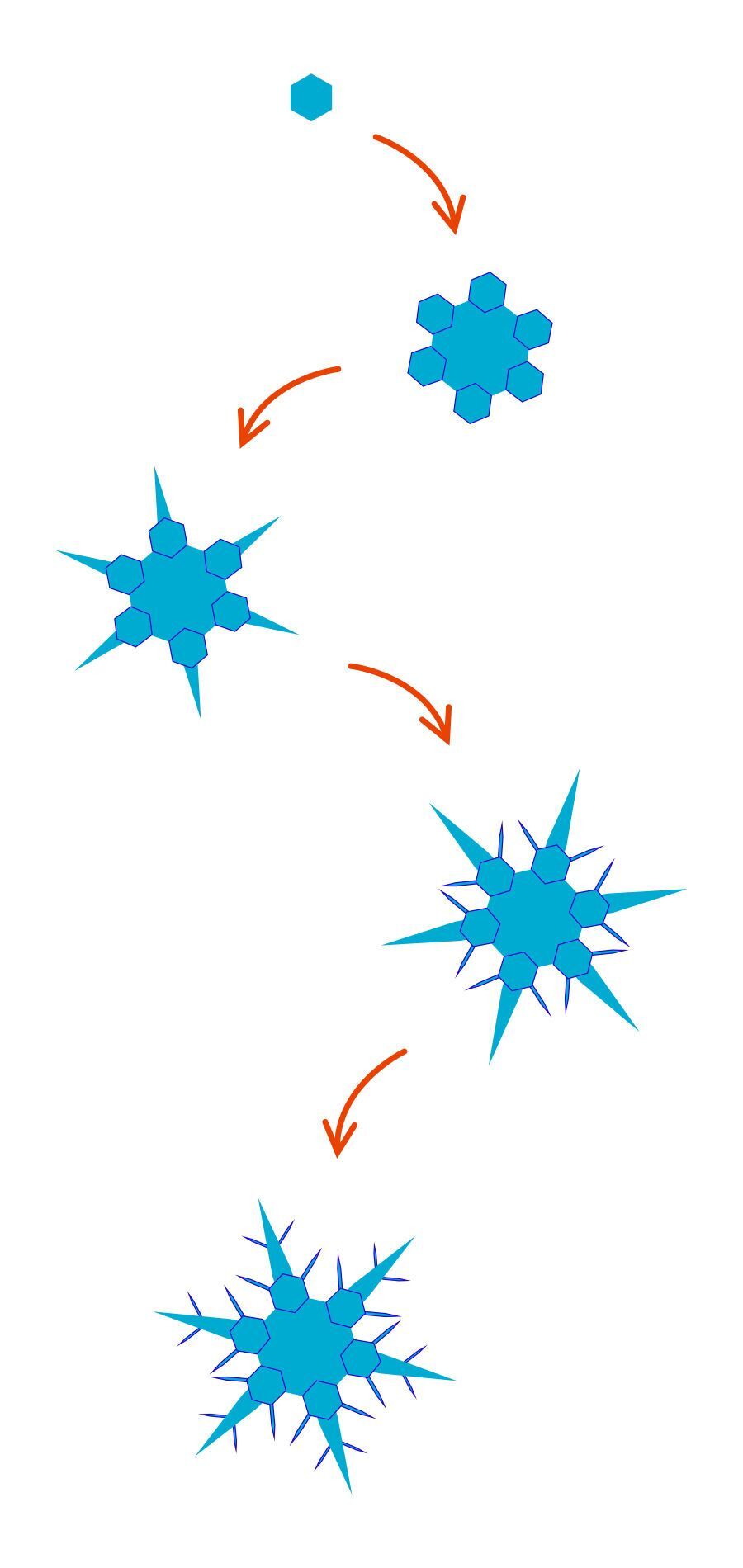
How snowflakes form
Source: IFLScience
Kenneth Liebbrecht, a professor of physics at the California Institute of Technology, noted that sometimes snowflakes can even be triangular, and in rare cases, they can be shaped like perfect equilateral triangles.
The professor emphasized that this is not a new discovery - triangular snowflakes were "documented" 15 years ago.
For a long time, no one could solve this puzzle. Prof. Liebbrecht explained that triangular snowflakes require certain conditions: a temperature of -14 °C and optimal humidity. Special crystal shapes are formed from a certain instability and require a very narrow window of environmental conditions.
The theory is based on the fact that the surface structure of ice depends primarily on temperature. The top layer can melt, changing the mobility of molecules. All snowflakes undergo preliminary melting, but micro changes in humidity and temperature also affect their shape.





Are there any identical snowflakes?
"Whether or not there are two identical snowflakes depends on what you mean by identical. What do you mean by a snowflake? In the lab, we make tiny, tiny snowflakes the diameter of a human hair, and most of them are regular hexagons, and they all look alike," said Prof. Liebbrecht.
Under natural conditions, there is an extremely low chance that two snowflakes will fall at the same time and in the same way, while facing the same conditions and the same melting in the process. Even in laboratory conditions, it is almost impossible to create absolutely identical snowflakes.
Subscribe to the OBOZ.UA channels in Telegram and Viber to keep up with the latest events.

 Subscribe
 Subscribe