












The comet, which last approached the Earth 160 thousand years ago, was filmed from the ISS. Photo


NASA astronaut Don Pettit from the International Space Station (ISS) took an amazing picture of a super-bright comet called C/2024 G3 (ATLAS). This tailed beauty last approached the Earth 160 thousand years ago.
In the impressive image, ATLAS lights up the entire night sky. The astronaut posted the photo of the comet, which seems to be moving beyond the Earth's horizon, on his page on the X network.
"It's absolutely amazing to see a comet from orbit," Donald Pettit wrote in a post on X.
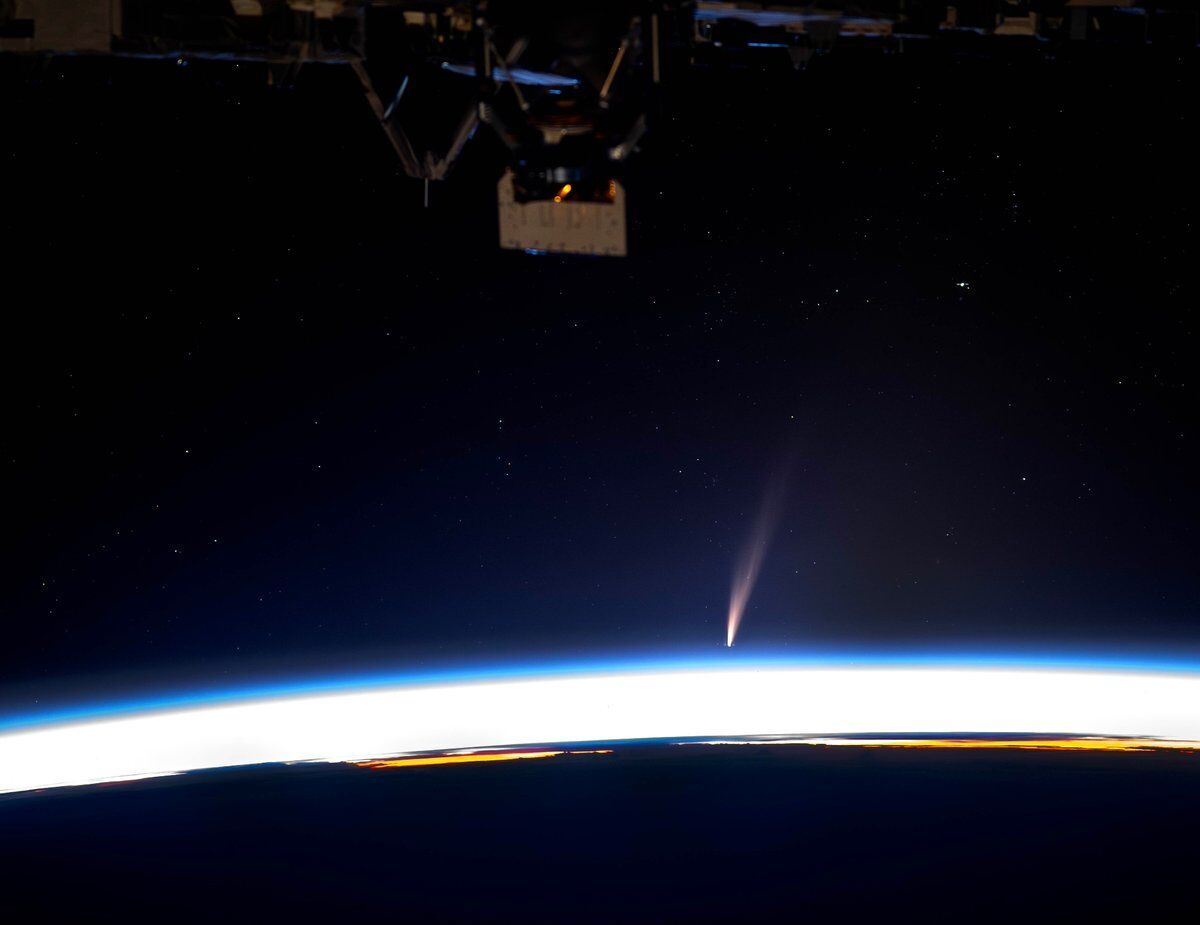
"Comet Atlas C2024-G3 has come to visit us," Don Pettit.
Source: x.com/astro_Pettit
The image clearly shows that the tail of C/2024 G3, which consists of gas and dust, seems to melt in the rays of the Sun, which also illuminates the atmosphere of our planet from its position behind the Earth, relative to the ISS.
As a reminder, the ATLAS comet came closest to Earth on January 14, at a distance of 142 million kilometers. A day earlier, the comet reached perihelion, its closest point to the Sun, making it shine as bright as Venus in the night sky for several nights.

Comet C/2024 G3 reached perihelion on January 13.
Source: NASA/JPL
According to the scientists, C/2024 G3 was first discovered in April last year when it began to race toward the Sun. Since then, astronomers have calculated the comet's trajectory through the solar system and found that it has a very elliptical or elongated orbit around our home star.






Now ATLAS will return to the Oort Cloud – a reservoir of comets and other icy objects hiding near the edge of the solar system – and probably will not return to the inner part of the solar system for at least 160,000 years.
Only verified information is available on the OBOZ.UA Telegram channel and Viber. Do not fall for fakes!

 Subscribe
 Subscribe