












NASA telescope has found the best evidence of the existing atmosphere on burning Super-Earth



The James Webb Space Telescope has detected the atmosphere around the planet 55 Cancri e, which is 41 light-years from Earth. Its orbit is only 2.25 million kilometers from the luminary, which indicates that the surface of the celestial body should be molten.
According to the researchers, 55 Cancri e is twice as large as the Earth, which is why it was called Super-Earth.
Previous studies have hinted at the presence of an atmosphere rich in volatile substances - gases such as nitrogen, oxygen, and carbon dioxide - on 55 Cancri e. But astronomers could not rule out that the planet's proximity to its star means that its atmosphere has long since disappeared, except for a veil of dust formed by the evaporation of molten rock.
The results of research by the James Webb Space Telescope confirmed that the planet has an atmosphere. Although the technique was unable to take a direct image of 55 Cancri e, it is able to detect subtle changes in light as the planet orbits the star.
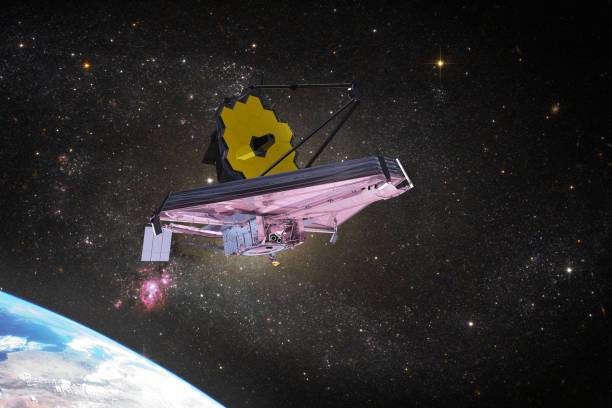
The James Webb Space Telescope is an American orbiting infrared space telescope.
Source: iStock
The first sign that the planet might have an atmosphere came when astronomers realized that it was actually much colder than expected.
According to previous estimates, the daytime temperature of 55 Cancri e should have been around 2200°C, almost half the surface temperature of our Sun. Instead, data from MIRI (a NASA instrument) show that the temperature is "only" 1,500°C.
"This very clearly indicates that the energy is distributed from the day side to the night side, most likely due to the volatile atmosphere," lead author Renyu Hu of NASA's Jet Propulsion Laboratory (JPL) says.
The spectroscopic method is based on observing which wavelengths of light are absorbed when a planet passes in front of a star. These wavelengths can be assigned to specific atoms or molecules.
"We see evidence of a dip in the spectrum between 4 and 5 microns: less of this light reaches the telescope. This indicates the presence of an atmosphere containing carbon monoxide or carbon dioxide, which absorb these wavelengths of light," study co-author Aaron Bello-Arufe explains.






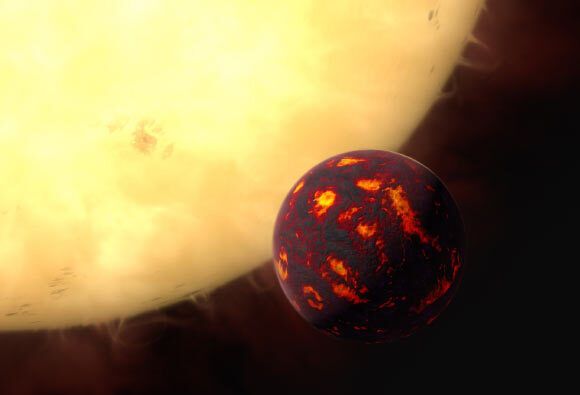
Super-Earth is so close to its luminary that its surface is probably molten.
Source: NASA
This atmosphere, however, is likely to be short-lived, and is being released from the planet's interior.
"The primary atmosphere would have disappeared long ago due to the high temperature and intense radiation of the star. This is probably a secondary atmosphere, constantly replenished by the magma ocean. Magma is not only crystals and liquid rock, it also contains a lot of dissolved gas," Bello-Arufe said.
Only verified information is available on OBOZ.UA Telegram channel and Viber. Do not fall for fakes!

 Subscribe
 Subscribe