










Cholera and E. coli found in Kherson region after Kakhovka HPP explosion: what are the risks?


In Kherson region, cholera and E. coli were found in the water after Russian troops blew up the Kakhovka hydroelectric power station. There have been no outbreaks of disease so far. To avoid getting infected, you should only drink disinfected, well-treated water, preferably bottled water. After the flood level drops, the wells can be used only after they are cleaned and samples are tested in the laboratory.
This was stated by Oleh Pavlenko, Head of the State Land Resources Supervision Department of the State Ecological Inspectorate of Ukraine, at a briefing at the Military Media Center. He said that the south of our country is now under constant monitoring, with experts taking water samples and analysing them daily.
"There is no major contamination, but there have already been several cases of cholera and E. coli detected. The sanitary and epidemiological station is conducting analyses in parallel with us, which monitors the sanitary and epidemiological situation, as many settlements, outbuildings and sewers have been flooded. We are examining the water in terms of chemistry, and they are examining it in terms of biology," Pavlenko said.
The official Telegram channel of the Kakhovka HPP explosion response headquarters also stated that there had been no outbreak of infectious diseases as of 13 May. "However, experts emphasise the importance of preventive measures," the post reads.
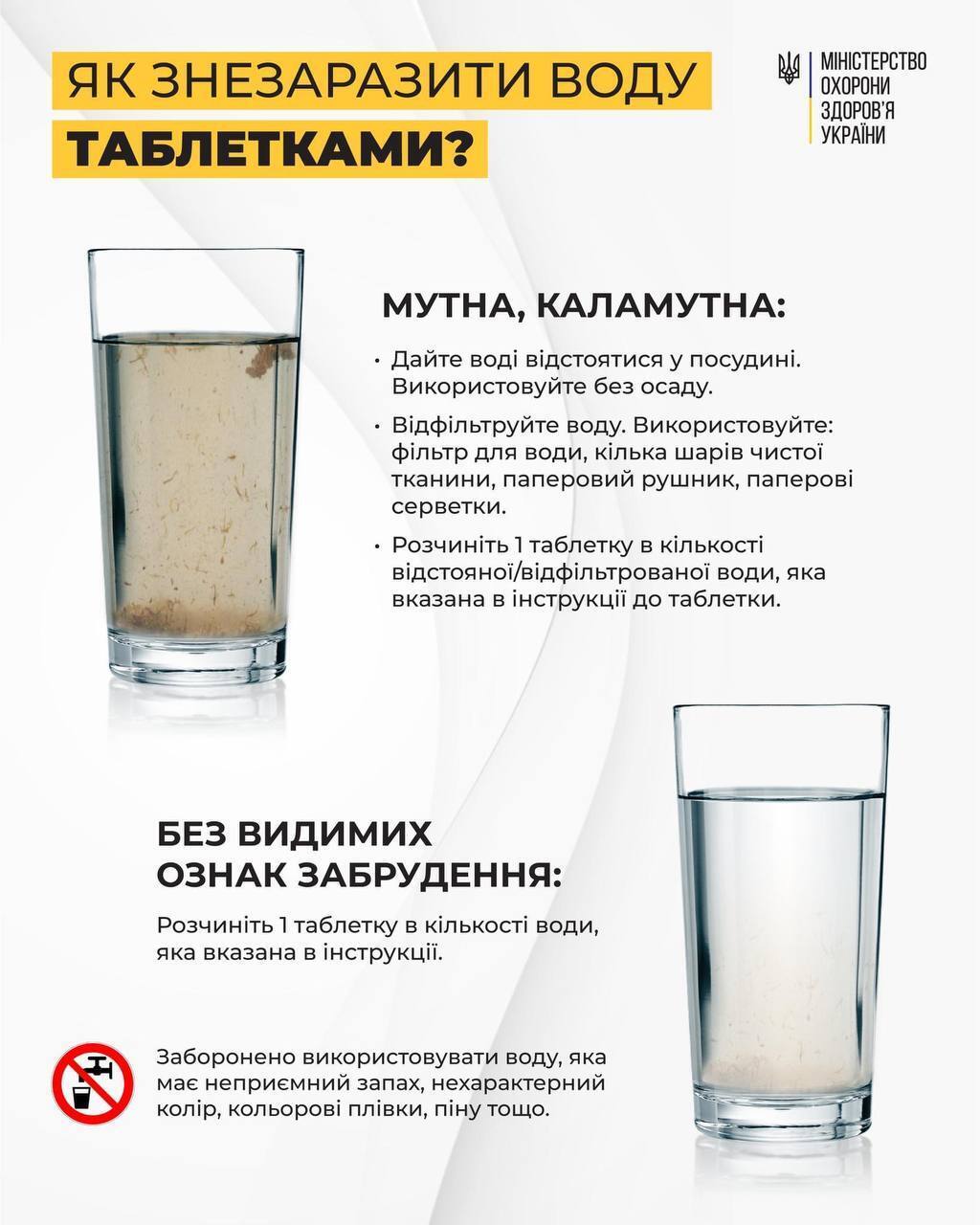
How to disinfect water
Source: Telegram "Kakhovskaya HPP | Staff info"
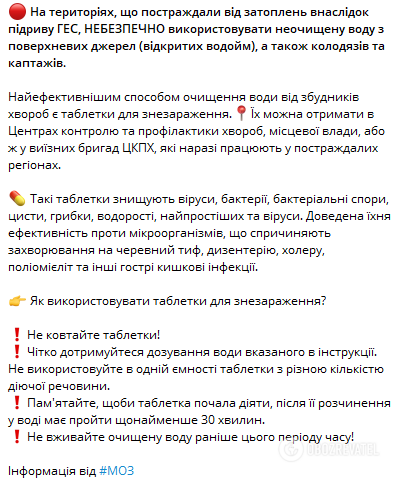
A warning from the Ministry of Health.
Source: Screenshot of Telegram "Kakhovskaya HPP | Staff info"
Cholera is an acute diarrhoeal disease caused by the bacteria Vibrio cholerae. It can be almost asymptomatic, but in severe cases it can be life-threatening.
As for E. coli, most strains are harmless and live in the intestines of healthy people and animals, but some, such as E. coli (O157:H7), produce powerful toxins and can cause severe illness.
In some people, especially children under 5 and the elderly, the infection can also cause a complication called haemolytic uremic syndrome, in which red blood cells are destroyed. About 2-7% of infections lead to these complications.






As OBOZREVATEL wrote earlier:
- UN Under-Secretary-General for Humanitarian Affairs and Emergency Relief Coordinator Martin Griffiths said that the destruction of the Kakhovka HPP would create major problems for the world's food security. This will lead to an increase in global food prices and may cause problems with drinking water for hundreds of thousands of people.
- For more information on how the enemy's explosion of the hydroelectric power plant will affect industrial production and agriculture in southern Ukraine, please read our material here.
Only verified information is available in our Obozrevatel Telegram channel and Viber. Do not fall for fakes!

 Subscribe
 Subscribe